Our Day at the Hatton Gym

Myself and my lovely wife Jen were spoilt yesterday with a trip to the Hatton Gym near Manchester to experience life as a professional boxer (for 1 day). I don't think I'll be turning pro any time soon but the experience was fantastic and a real insight into the 'behind the scenes stuff'.

As someone who is passionate about training health and fitness, I'm well aware that in sport, often there is a big divide between best practice and what is actually done.  However, I must say that what we witnessed in the Hatton camp was very impressive and goes to show that modern methods are being employed at the top level.

Ric Moylan, head fitness coach at camp Hatton explained "I took my role a couple of years ago and I must say that it's been a difficult journey arriving at what you see today". Ric went on to say "When I started working in pro boxing, I had to combat a lot of beliefs and indoctrination that had been embed into the mindset of boxers"

Ric's first challenge was to get boxers to start lifting weights. This may sound surprising but many boxers now under Ric's wing believed that weight training would lead to adding bulk, slowing down their speed and ultimately making them heavier. One of the most crucial elements of boxing is weight. Staying light whilst maintaining high strength and power ratio is crucial to help fighters step into the ring with the advantage over the oponent. Ric managed to educate them that having more strength would help them hit harder and this seemed to do the trick. It wasn't an immediate transition though as many boxers have been set into a training mentality since the age of 6 or 7 years old.

Myself and Jen in the circuit - we were that quick it was a blur!!

Another challenge that faced Ric was getting the training more functional and specific to the skills and attributes that a boxer needs. At his starting point, many of the boxers were running 8-10 miles daily. Now, on the face of it, this may appear to demonstrate a very high level of stamina and aerobic conditioning, a much needed part of boxing. However, boxing is about speed and power, long distance running doesn't demonstrate this and causes the body to adopt an often catabolic state. This causes muscle tissue to be used as energy and fat to be stored. Not ideal at all for boxing. Furthermore, a lot of the movements the boxers were using for conditioning were very linear, straight lined and single plane. Again, boxing is multi-directional, includes a lot of rotation and requires constantly changing positions. Now a couple of years in, Ric has managed to introduce kettlebells, more diverse free body conditioning and many other more functional modes of fitness conditioning.


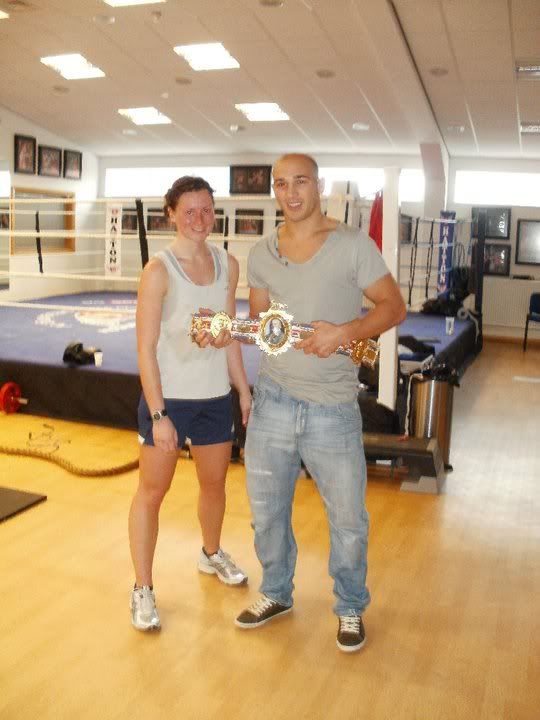
Jen with one of the Hatton camp prize boxers

The final thing was nutrition and getting boxers to eat well. An experienced nutritionist, Ric is well aware that when it comes to diet, there is no single solution for all of us. "Just because porridge in the morning may work for one fighter doesn't mean it will for another". All these low fat, low carb and low GI diets just send confusing messages out leaving people feeling uncertain and desparate and often athletes can be amongst the most vulnerable due to the pressure of high level sport". Getting a healthy balanced diet is a process and involves negotiation. The foods have to be balanced, leave no negative effects post meal, but must also be a compromise of what is realistic and what the individual enjoys. There's no point forcing someone to eat nuts if they don't like them".

It's no coincidence that now a few years in, the Hatton camp are seeing more and more prize winning athletes with British, Commonwealth and European titles decorating the club. With an increase in the talent pool and many shining stars on the horizon, it's great to see that sensible and educated approaches achieve excellent results. Cheers for a great day Ric!!


How to lose personal training clients

This may appear a strange title for a blog, after all, there can't be that many occasions when trainers are looking to off-load clients. Moving abroad? Industry change? I'm sure you can agree that most coaches would be far more interested in how to keep hold of clients. This is quite a difficult art to get across as it is completely relative to the type of clients you have and their behaviours. So why am I writing this? Well, after years of managing, mentoring and assisting personal trainers, it's much easier to point out the things that send clients packing. Therefore, if you can avoid making these mistakes, you'll be well on your way to keeping hold of those coveted lifetime clients:

  • Making suggestions is better than being a dictator. Ok, we've all got areas of expertise and great knowledge that can hugely benefit clients. Some clients will take your suggestions on board straight away, others may have the best intentions and lack the execution and others may dismiss it. That's just life and we all have different beliefs that can often shape how we accept information. Being a personal trainer is a very privileged position and clients will often confide in you leaving you advising on all sorts of areas of their life. Demanding clients to make certain choices is patronising and an abuse on the client-trainer relationship. Not only does telling clients what to do pre-suggest they don't understand right from wrong, it also pre-supposes that what you are saying is absolute fact. Unless you've conducted your own empirical research, your knowledge is based on the teaching of others and we all work in a fast moving industry where research can often contradict the practises of decades. The last thing you want is a client turning up in a few years time blaming you for telling them to make a certain decision. Simply make suggestions.
  • Give your clients choice. Some more than others but we all enjoy a degree of control, especially in our day to day lives. Giving your clients choice over the exercises they do, the food choices they make and the paths they lead will not only help them to start making more informed choices, it also gives them a certain ownership over the programme which will aid their level of commitment.
  • Listen to your client. It baffles me how many assumptions are made by people working in the fitness industry. A friend of my wife recently joined a gym. For the purposes of this article, let's call her Sarah. Upon Sarah's induction, she was met with a young and enthusiastic fitness instructor who's job was to fully introduce Sarah to the gym and give her a tailored programme. Sarah is sporty and has been for years. Her aim was to improve her strength and her performance in hockey. "So, where are you looking to lose weight from?" was the first enquiry of the instructor. "I'm not looking to lose weight, I just want to improve my performance in hockey, improve my speed and strength". "Ok, obliged the instructor". The first machine introduced was a seated adductor machine "This will help you lose weight and tone around your inner thigh". Sarah retorted "I'm not looking to lose weight, I just want to know how to increase strength". This went on and 3 or 4 more exercise stations were shown that could apparently burn fat like no other. Whilst many clients are looking to change aesthetics in someway, this isn't a pre-cursor for every client. Listen to what your client wants and relate everything to that. There's a big hint in what clients want. This is precisely what they value.
There's plenty more examples of common errors that are made. I'm sure you've seen some too. Please add to this with experiences that you've witnessed.

Putting together the perfect CV

I get asked quite a lot about how CV's should look by fitness professionals. As much as my experiences have told me quite a few things, I'm certainly no expert in CV writing.

A close friend who runs a hugely successful marketing recruitment consultancy put together this video with his top pointers on CV writing. Whilst it's designed for marketing professionals, the points are absolutely relevant for anyone in the fitness industry. If anyone knows how to put together CV's then Jonathan does. His company see thousands of CV's every year and know the difference that makes the difference.

Make sure you don't miss that position and watch this video!!

Ask the right questions

As trainers, we can often get very tied up in the mechanics or finer detail of exercises or nutrition and lose sight of the bigger picture.

When looking after coaches, I often see such dedication to helping clients move properly, understand the exercises and know which muscles should be working and it's great to see. All that time spent keeping the eyes open whilst preparing for an anatomy and physiology exam really was worth it. The question is, can it be lost on your clients or could it be put across more effectively.

I'll put my hands up right now in acknowledgement that my passion lies in depth of detail. I can often lose myself let alone a client when talking about the microscopic inner workings of shoulder mechanics through abduction but is this really necessary??


The fact that you probably spent time looking like this when revising late into the evening for your exams is proof enough that some theory is intended for exams and you only. Unless your client is a biomechanist or extremely inquisitive, give them simple terms and the benefits of the exercise...that's all they need.

Here's some additional pointers for speaking effectively to your clients:

  • Use the simplest descriptions that make sense to your clients. For example, we all know that getting the glutes working properly will support most standing or upright exercises and help reduce synergistic dominance. Explaining synergistic dominance in scientific detail to your client isn't necessary. If your client likes cars or is a mechanic then simply explain 'without the glutes, doing these exercises would be like running a car without 1st or 2nd gear - very inefficient!'
  • Don't over-ask your client 'How are you?' This isn't me being inconsiderate but the fact is, you're spending time conditioning your client and this can be physically and mentally demanding. Time and time again I hear trainers ask clients 'How you doing?' mid-session. The intention is great and endearing but the response is limited. What can you expect your client to say when they're working hard?? 'I'm shattered' or ' Can't speak'. Be specific with your questions and help lay down expectations. If you're doing shoulder exercises then explain that you are looking to work the shoulder muscles and that fatigue in those areas is a good thing. Asking where they are feeling particular exercises is a much more specific and useful question to help you coach. Asking your client their state at the beginning of the session is obviously a pleasant greeting although 'Are you well?' is even better as this nudges them towards giving a positive response.
  • When coaching through demanding sessions, there may be times where your client is unable to verbalise a response but this doesn't mean you cannot interact. Getting them to nod or make a gesture in response to your statements can be enough to keep a healthy rapport and here is a simple but brilliant way to do it. Add tag questions on the end of your statements and encourage your clients to agree with you. 'Knowing that you're doing the exercise properly makes a big difference, doesn't it?' You don't demand a response other than an acknowledgement and your client will be unconsciously taking steps towards agreeing with you and building that trust and rapport. Knowing how to build the relationship between you and your client is going to help the growth of your business isn't it?
I hope this helps and make sure you add some comments

Mastering the swing

If you haven't put yourself on a kettlebell course yet then it may just be something to consider to start helping your clients achieve huge results.

Pushing the fantastic results from the metabolic style training aside, the movements associated with kettlebells hugely helps some common problem areas that we see with clients. Correct me if I'm wrong but tight psoas, weak glutes, weak transverse abs and tight shoulders can often hamper posture and movement ability. Never has there been one set of exercises that can specifically target and benefit these areas.

The kettlebell swing is one of the most fundamental patterns of kettlebells and very unique to them. Getting it right is key though...

 My advice is to get qualified before using these with clients and always look to master these movements yourself. This can take a little practise but knowing the movements inside out yourself will give you the deep understanding that you need as a good coach to get your clients mastering the movements and getting the results they're after.

A great pulse raising circuit is simply alternating kettlebell swings with bodyweight patterns:

1 min swings
1 min push ups
1 min swings
1 min squats
1 min swings
1 min alternate reverse lunges

15-30 sec recovery in between, complete twice for intermediate and 3 times for advanced.

Know yourself for complete success

Having worked my way from being a personal trainer as well as then managing hundreds, I have first hand experience of the challenges and battles that face building a successful business.

The challenges are many but the rewards are potentially so good they outweigh these. Being able to manage yourself, your business and be in complete control of your time is a true blessing. For me, the greatest challenge of all is yourself and this isn't just a challenge that you face once but an ongoing journey that everyone who decides to operate self employed should commit to continually reflecting on.

The thing is, in a job environment, you have your set parameters. You have (in most situations) a clear role description and understand your responsibilities as well as a team of people around you who are there to guide, support and work cohesively alongside you. If a scenario occurs that you know isn't within your remit, you know who or where to go with it ensuring that it is dealt with properly.

As I mentioned, I'm speaking from personal experience and in the early days, like most trainers out there, my priority was to build a business and I made mistakes of wanting so hard to please clients and potential clients that I would try and be the expert of everything. Let's face it, if you were the expert on all matters relating to health and fitness, you wouldn't have time in the day to speak with clients. The industry, research and trends move so fast that you would have to keep your head in books every hour of every day and still, that time wouldn't be quite enough.

The key is to know yourself, your strengths and what you enjoy. Inversely, know your weaknesses, what you're not so great at and what you don't enjoy. Being honest with yourself on this and aligning this knowledge to how you project your professional status to your clients will bring you a much stronger chance of a long and successful business. Trying to profess in areas that are a little out of your comfort zone is an extremely dangerous strategy that puts you, your client and the lifespan of your reputation at risk. Giving clients the best possible service whether it means you delivering the work or referring them to the best placed individual is absolute best practise and you'll benefit on many levels. Clients will give you the credit for having directed them in the first place and you'll be able to start developing a successful referral scheme with other professionals. The other side is that, knowing your strengths will help you understand your niche and areas of specialisation. Again, these may change through your career and continually reflecting on knowing yourself, strengths and weaknesses will help you be in tune with this.

Whilst businesses survive on cash flow, prioritising giving the best value to the customer over putting the most value in your pocket in the quickest time will help keep your business alive and flourishing longer term.

Is your FREE consultation enough?

Being the festive period all about giving, it struck me as a good time to think about service offerings and the facility we create to entice new clients into using our services.

In my experience, personal trainers offer a free consultation, session, postural appraisal or introduction into a specialist style of training. Whilst this makes absolute sense, afterall, it is a service and what better way to promote a service than to give someone a taste, is it really enough or is it the best way to bring on new clients? Well, only your conversion rates will clarify whether you're getting the results you want. There are a number of challenges with getting new clients. Letting potential new clients become aware of your services, getting new potential clients infront of you and then finally converting them into a paying client. If it is only a free session that you promote to new potential clients, is this enough to differentiate you from your competition??


Without knowing your client fully, how do you know that a taster session is going to be right for them or what to focus on?

This is not the gospel but the following may be things that you want to consider with bringing new clients on board:

  • Pre-taster screening - Get to know your client before you give them a free session. Health and medical screening should be part of this but the more you understand about the person, the more appropriate you can make the taster session for them. Understand their likes and dislikes with exercise, their motivations, their buying strategies etc. If you want to know more about how to find these things out with simple questions, contact info@creatingchaos.co.uk for more detail
  • The taster session - Avoid delivering a template session that you give to everyone. If you work in a gym then this will become very obvious to the by-standers. I'm not saying avoid a template as this will help you structure the session but make the specific content relevant. If nutrition is much the bigger area then focus more on this. Fancy exercises don't impress everyone!!
  • Post taster report - Let people know how they did. If you've looked at posture or function then give the individual a report / some feedback. This should come with a huge caveat. Avoid depressing people with the bad news and be tactful when giving feedback. Using a very typical management style, give some good feedback followed by an area that could be improved followed by some more encouraging feedback. For example "You've got excellent flexbility which will help us achieve great results. We can work on your core strength quite a lot and combined with your lower body strength we'll be able to make waves in your training." Notice that the example doesn't give excessive terminology and this is something I see trainers do constantly - overwhelm the client with irrelevant information. It is fantastic that you can identify reciprocal inhibition of the glutes from the Psoas Hip flexor but this doesn't really mean much to the client. The language of most clients is results and by when...remember this! There are exceptions and if you're clients enjoy understanding about the anatomical elements then meet that demand when you're able to.
  • Offer an incentive that is results based - This shows how confident you are as a trainer. Clients want results and if you offer them a reward for achieving results then this will not only sell and promote your services but it will act as a motivator during the programme which is another challenge for you. This may be in the shape of free sessions or something that is more of a tangible gift. It may be a pair of good running trainers / training gear or indeed anything. This may seem like too much but is it really? Think about it, how much are your clients worth per year? £2,3,4 or 5,000? It would be much better spent money to keep hold of a client than to have to market more for new clients and then find the client of the same value to your business.
A few ideas and hopefully some festive food for thought. Please leave comments and add your suggestions.